Web Development
Direct Booking Engine for Small Hotels: How to Save on OTA Commissions (2026)
OTAs cost small hotels 15–22% of every booking. What a direct booking engine costs, how fast it pays back, the new rules that let you price lower on your own site, and eight ways to grow direct bookings.
On this page
- How much do OTAs really cost hotels?
- Can you charge less on your own website than on the OTAs?
- What is a direct booking engine?
- How much does a direct booking engine cost?
- How fast does it pay back?
- 8 ways to grow direct bookings
- Features a hotel booking engine should have
- Ready-made booking engine or a custom system?
- How do you measure your direct share?
- Bottom line: when to invest in a direct booking engine
- Frequently asked questions
Short answer: A direct booking engine is the most effective way for an independent hotel to cut OTA commission. online travel agencies typically charge hotels around 15% base commission, and 17–22% once visibility programmes, member discounts and payment fees are added. A direct booking engine on your own website starts at about $1,200 for small properties and $3,500 for a full system with payments and channel sync. A 12-room boutique hotel that turns a fifth of its OTA bookings into direct ones usually pays the system back within a single season.
OTAs are excellent at putting your property in front of travellers who have never heard of you. The trouble is what happens next: when that guest comes back next year, or a friend searches for your hotel by name, the booking often still goes through the OTA — and you pay commission again on a guest you already earned.
This guide is for independent hotels, B&Bs, guesthouses and villa operators. It covers what OTAs really cost, what a direct booking engine costs to build and run, how quickly it pays back, and how to grow direct bookings without losing the OTA guests you still need. Figures are current as of October 21, 2026.
How much do OTAs really cost hotels?
OTA commissions are set in each property’s contract and vary by market. Industry estimates for Booking.com in 2026:
| Cost item | Typical rate | Notes |
|---|---|---|
| Base commission | ~15% | On the total booking value |
| Preferred Partner Programme | +2–3 points | Optional, for more visibility in search |
| Genius discounts | Discount funded by the property | Commission still applies to the pre-discount rate |
| Payments by Booking.com | 1.1–1.4% | Processing fee on top of commission |
| Real total cost | ~17–22% | Depending on which programmes you join |
The quickest way to see your own number: add up the last 12 months of OTA invoices and divide by the revenue those OTAs delivered. Many owners are surprised the first time they do it.
Can you charge less on your own website than on the OTAs?
In the European Union, yes. On 13 May 2024 the European Commission designated Booking.com a gatekeeper under the Digital Markets Act, and its obligations have applied since November 2024. Parity clauses are prohibited: hotels can offer different, including better, prices and conditions on their own website or other channels, and Booking.com may not use measures with the same effect, such as raising commission or demoting hotels that price differently.
Elsewhere, regulators are moving too. In Turkey, a bill approved by a parliamentary committee in October 2026 would cap domestic OTA commission at 17% from 1 January 2027 if enacted. Outside such rules, check your contract’s rate-parity terms before you advertise lower direct prices — but member-only perks (free breakfast, late checkout) are a common way to reward direct guests regardless.
What is a direct booking engine?
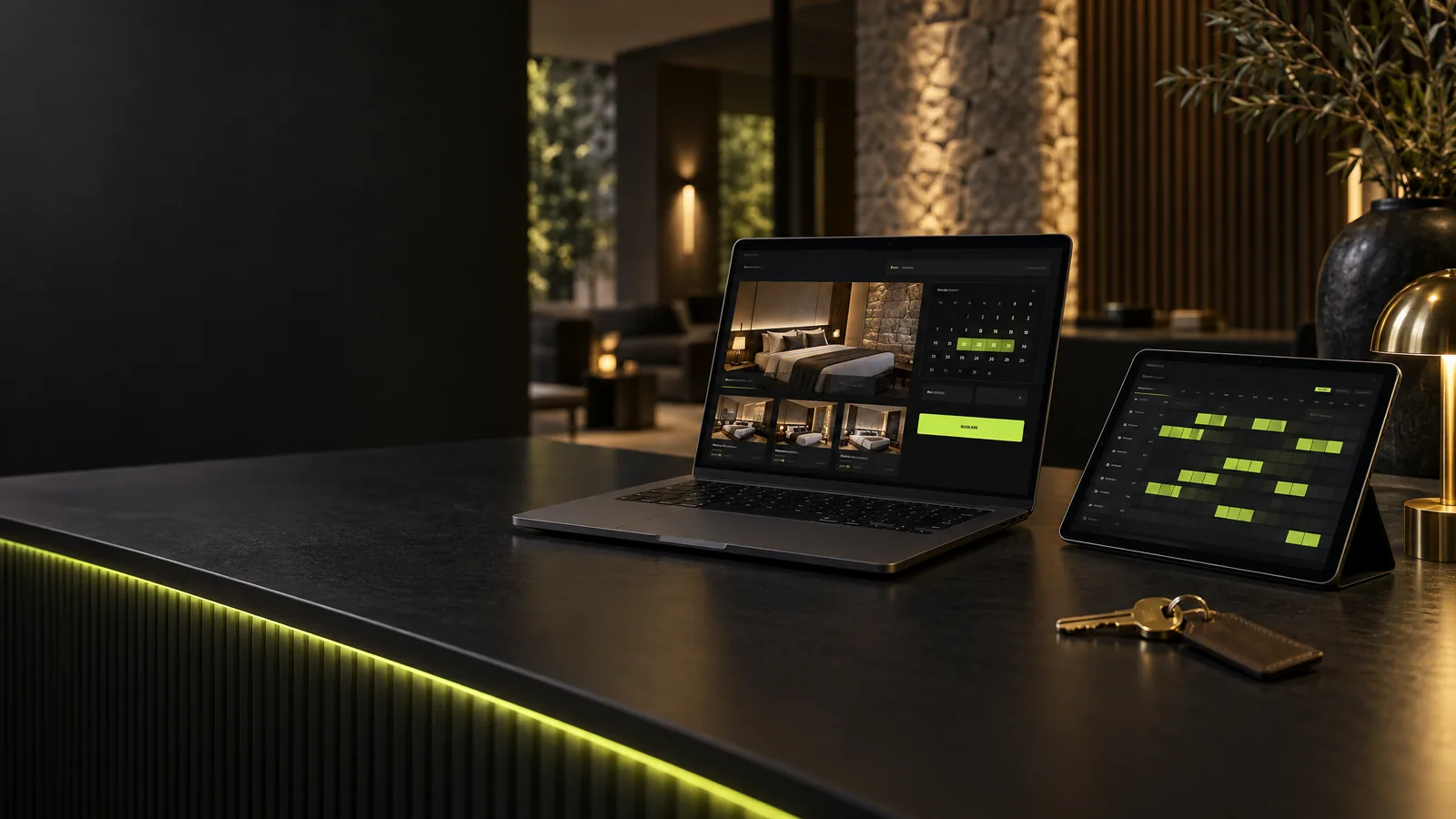
It’s the booking system on your own website. Guests pick dates, see available rooms and prices, pay a deposit or the full amount by card, and the reservation lands in your system instantly. You pay no commission — only card processing and small monthly running costs.
A good engine isn’t just a form. It must share availability with your OTAs so the same room is never sold twice. Small properties do this with iCal calendar sync; larger ones connect a channel manager or property management system (PMS).
How much does a direct booking engine cost?
| Property type | From | What’s included |
|---|---|---|
| Guesthouse, villa, small boutique hotel | $1,200 | Rooms and availability calendar, booking requests or deposit bookings, email confirmations and reminders, admin panel, iCal sync with OTA calendars |
| Boutique and city hotels | $3,500 | Online payment and deposits, seasonal and promotional rates, minimum-stay rules, WhatsApp/SMS notifications, guest history, reports |
| Multi-property operators | $7,500+ | Multiple properties and roles, channel manager/PMS integration, memberships and loyalty, accounting integration, mobile app |
Running costs are small: card processing (Stripe’s standard US card rate starts at 2.9% + 30¢; local gateways are similar or lower), $10–30 a month for hosting and domain, and very low notification costs.
How fast does it pay back?
- 12-room boutique hotel, $150 average nightly rate, 65% occupancy in season → about $35,100 room revenue a month
- 60% of it from OTAs → about $21,060 a month
- OTA real cost 18%; direct card processing about 3%
- Saving on every $100 moved direct: about $15
| Share of OTA bookings moved direct | Monthly saving (in season) | Payback on a $3,500 system |
|---|---|---|
| 10% | ~$316 | ~11 months |
| 20% | ~$632 | ~6 months |
| 30% | ~$948 | ~4 months |
The variable that matters most is how many OTA guests you can realistically turn direct. First-time discoverers will keep arriving through OTAs. Returning guests, people who search for your property by name and your social-media followers will book direct if you give them a reason.
8 ways to grow direct bookings
- Offer a book-direct perk: free breakfast, early check-in, late checkout, a transfer or a small discount where allowed. Without commission you can afford it and still earn more.
- Show live prices: “Call for rates” sends guests straight back to the OTA. Instant price and availability are a must.
- Own your name on Google: keep your Business Profile’s website and booking link current. Free booking links on Google Hotels require a compatible booking engine or channel manager connection.
- Stay in touch with past guests: send opted-in guests a returning-guest offer before the season. OTA guest contacts often stay with the platform; direct guests are yours.
- Take bookings on WhatsApp: in many markets guests prefer messaging. A WhatsApp button or booking bot converts questions into reservations.
- Turn Instagram into a storefront: link your bio straight to your booking page.
- Make the site fast and mobile-first: most guests browse on phones; a slow, confusing site sends them to your most expensive channel.
- Speak your guests’ languages: if you host international travellers, pages in their language help them book without going through an OTA.
Features a hotel booking engine should have
- Room types and availability calendar with instant results for any date range.
- Flexible pricing: seasons, weekends, minimum stays, early-bird and long-stay discounts.
- Deposits and prepayment with automatic refund rules based on your cancellation policy.
- OTA sync via iCal or a channel manager to prevent double bookings.
- Automated messages: confirmation, pre-arrival info, post-stay thank-you and review request.
- Guest records so you recognise returning guests and their preferences.
- Reports: revenue by channel, occupancy, average daily rate and direct share.
- An admin panel you can run yourself — change rates and availability without a developer.
Ready-made booking engine or a custom system?
| Subscription booking engine | Custom system | |
|---|---|---|
| Cost | Monthly fee, sometimes per-booking fees | One-time build + low running costs |
| Speed | Fast setup | 3–10 weeks |
| Design and brand | Limited to templates | Fully yours |
| Guest data | On the provider’s system | In your own database |
| Special rules | As far as the provider allows | Villas, rooms, packages, transfers — whatever you sell |
| Best for | Standard properties that want to start fast | Properties with a distinctive product or growth plans |
Starting with a subscription engine and moving to a custom system as your direct share grows is perfectly reasonable. Whichever you choose, make sure your domain and guest data stay yours.
How do you measure your direct share?
- Direct booking share: revenue from your website, phone and WhatsApp as a percentage of total room revenue. Watch the trend month to month.
- Net revenue per channel: revenue minus commission and payment fees. The biggest channel by gross isn’t always the most profitable.
- Returning-guest rate: guests who stay twice within a year, and which channel they booked through. A returning guest booking via an OTA is your biggest missed opportunity.
Bottom line: when to invest in a direct booking engine
Whatever happens with OTA regulation, a property with its own direct booking engine negotiates from a stronger position. The best time to build is the off-season: the booking engine is ready, the photos are shot and your returning-guest offer has gone out before demand peaks.
Key takeaways
- OTAs cost around 15% base and 17–22% all-in, depending on programmes.
- In the EU, the Digital Markets Act lets hotels offer better prices on their own site than on Booking.com.
- A direct booking engine starts at $1,200; a full system with payments and sync at $3,500.
- Turning 20% of OTA bookings direct pays back a $3,500 system in about six season months for a 12-room hotel.
- Keep the OTAs for discovery; use your own channel to keep the guests they bring.
Frequently asked questions
How much does a hotel booking engine cost?
A booking engine for a guesthouse, villa or small boutique hotel starts at about $1,200. A full system with online payments, seasonal pricing and notifications starts at about $3,500, and multi-property setups with channel manager integration at about $7,500.
How much commission does Booking.com charge hotels?
Industry estimates put the base commission around 15%, rising to roughly 17–22% once the Preferred Partner Programme, Genius discounts and payment processing are included. Your contract sets your actual rate.
Can I offer lower prices on my own website?
In the EU, yes: under the Digital Markets Act, Booking.com may not enforce parity clauses or penalise hotels that price differently elsewhere. Outside the EU, check your contract; perks for direct guests are a common alternative to lower prices.
Will my website and the OTAs sell the same room twice?
Not with a properly built system. iCal sync for small properties, or a channel manager integration for larger ones, keeps availability identical across channels. Test double-booking scenarios before launch.
Why would guests book direct instead of through an OTA?
Because you give them a reason: free breakfast, late checkout, a transfer or a better rate where allowed. Returning guests respond fastest to these offers.
How long does it take to launch?
Small-property booking sites usually go live in 3–5 weeks; full systems with payments and channel sync in 6–10 weeks. Start in the off-season so you’re ready before peak demand.
Should I leave the OTAs completely?
For most properties, no. OTAs remain the strongest way to reach new guests, especially from abroad. Use them for discovery and your own channel to keep the guests they bring.
Want the payback calculation with your own numbers? Send us your room count, average rate and OTA share, and we’ll reply within one business day with scope, timeline and a fixed price. Package details are on our booking system development page.