Web Development
Medical Tourism Website: What Clinics Need to Win International Patients (2026 Guide)
Türkiye welcomed about 1.4 million health tourists in 2025. What should a medical tourism website include to turn international visitors into patients, what do the 2025 Turkish rules require and forbid, and what does it cost?
On this page
- Why is a medical tourism website different from a normal clinic website?
- What do the 2025 Turkish rules require from a medical tourism website?
- What is allowed on a clinic website, and what isn’t?
- 10 features of a medical tourism website that wins international patients
- International patients’ health data: what to watch
- How much does a medical tourism website cost?
- Template or a custom clinic website?
- Bottom line: what makes a medical tourism website work?
- Frequently asked questions
Short answer: A good medical tourism website lets an international patient understand the treatment, the doctor and the process in their own language, then send their question and photos securely within minutes — on a fast, compliant site. For clinics in Türkiye, the site must follow two regulations renewed in 2025: authorized facilities must keep a website with a foreign-language option, promotion aimed at foreigners must run on a separate site or platform, and the #HealthTürkiye logo is mandatory. A multilingual clinic website starts at $590; a site with a patient inquiry system, photo upload and a coordinator dashboard starts at $2,400.
Türkiye is one of the world’s most popular medical tourism destinations. According to a DHA report dated October 18, 2026, the country welcomed about 1,399,000 health tourists in 2025 and earned roughly $3 billion from them, with average revenue per patient rising in the first half of 2026. The market is large, but competition is fierce: a patient in London, Berlin or Riyadh looks at dozens of clinic websites before deciding.
This guide covers what a medical tourism website needs to win international patients, what the 2025 Turkish rules require and forbid, and what such a site costs. Note: this is not legal advice — have your content reviewed by your legal adviser before it goes live.
Why is a medical tourism website different from a normal clinic website?
A clinic website for local patients can often get by with an address, a phone number and a list of doctors. International patients have to trust a clinic thousands of kilometres away, in a country they may never have visited. So a medical tourism website has three extra jobs:
- Build trust: Doctors’ expertise, the clinic’s authorization and accreditation, and a transparent process.
- Help patients decide remotely: How many days treatment takes, what the package includes (hotel, transfers, interpreter) and what follow-up looks like.
- Capture inquiries fast: Patients write from another time zone, on their phones and often on WhatsApp; the clinic that replies within the first hours usually wins the patient.
What do the 2025 Turkish rules require from a medical tourism website?
Two key regulations were renewed in 2025: the International Health Tourism and Tourist Health Regulation (Official Gazette No. 32882, April 26, 2025) and the Regulation on Promotion and Information Activities in Health Services (Official Gazette No. 33075, November 12, 2025). The rules that affect your website most directly:
- Authorization certificate: Health facilities and intermediaries serving foreign patients need an international health tourism authorization certificate and must be registered on the HealthTürkiye portal.
- Foreign-language website: Authorized facilities and intermediaries must keep a website with a foreign-language option.
- Separate platform: Promotion aimed at foreigners must run on a website or social account separate from content aimed at patients in Türkiye.
- #HealthTürkiye logo: Mandatory on foreign-facing platforms; the facility name, ownership details and URL must match Ministry records.
- No targeting of Türkiye: Sponsored promotion is allowed in languages other than Turkish, but audiences in Türkiye may not be targeted and automatic targeting features must be switched off.
- Update date and editor details: The site must show its last update date and the site editor’s contact details.
What is allowed on a clinic website, and what isn’t?
| Topic | Content aimed at patients in Türkiye | Foreign-facing platform |
|---|---|---|
| Advertising | Banned; promotion and information allowed within the rules | Promotion allowed within the rules |
| Patient reviews and thank-yous | May not be used as advertising | Allowed with respect for privacy and documented explicit consent |
| Before-and-after images | Must be taken in the same setting and technical conditions, with procedure and photo dates shown | Same rules apply |
| Prices, discounts, campaigns | Not allowed in promotion | Allowed under certain conditions |
| Superlatives such as “best” or “only” | Banned | Misleading content banned |
| Filtered or retouched patient images | Banned | Banned |
For patient images, written or electronic consent must be obtained with the standard form annexed to the regulation; patients must be able to see the image first and withdraw consent at any time. Comments, likes and shares must be disabled on patient images. Images taken during surgery or procedures, and images of intimate areas, may not be shared. The regulation also bans influencers and content creators from steering people to a doctor or clinic under the label of a “review” or “experience”.
Watch out: Health facilities can face administrative fines for non-compliant content, and images containing patient data can create separate liability under Türkiye’s data protection law (KVKK). Your web developer isn’t responsible for content decisions — the clinic and its legal adviser are. We build the technical side that makes compliance easier: separate language sites, consent records, comments you can switch off and visible update dates.
10 features of a medical tourism website that wins international patients
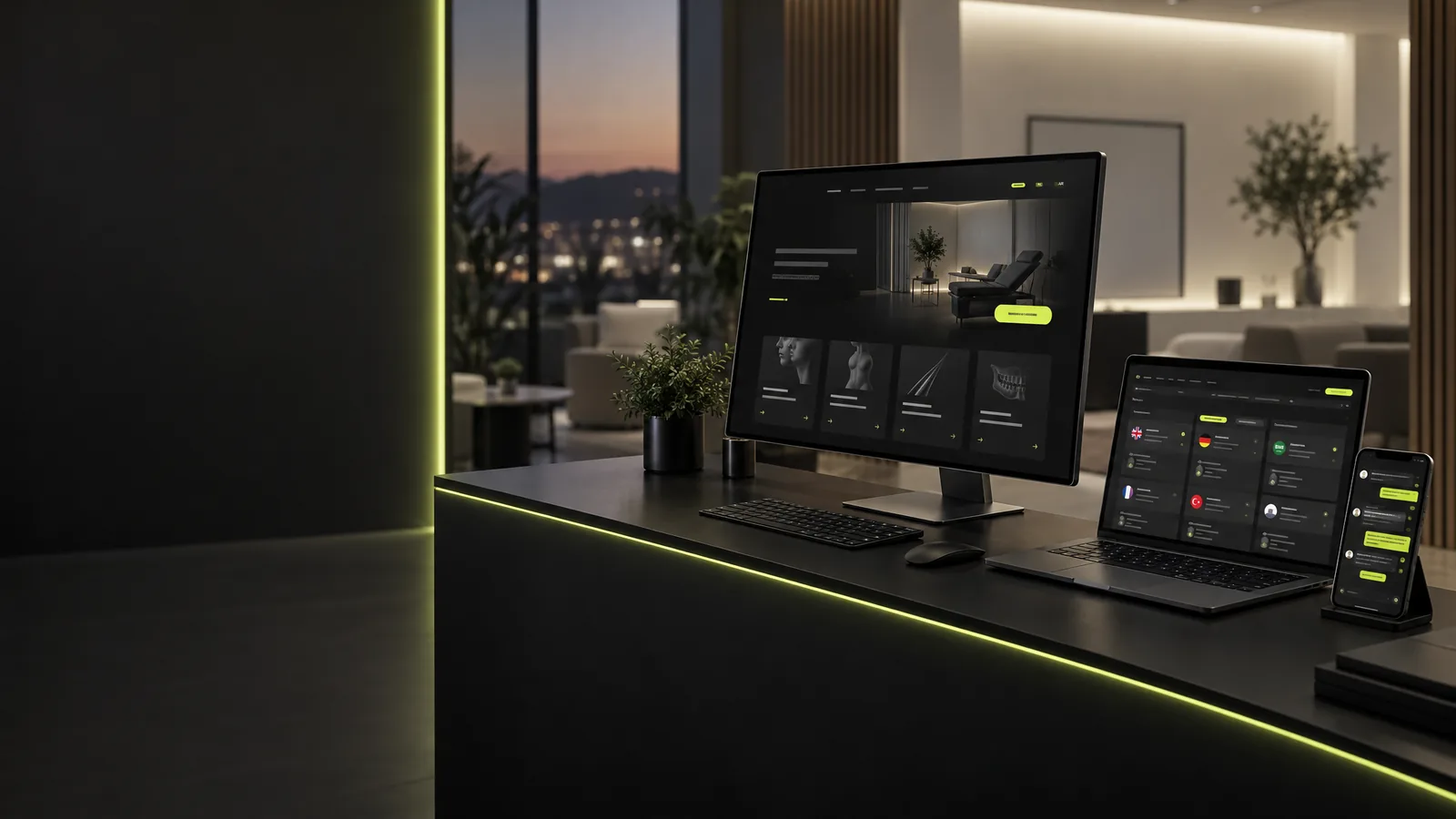
- Real translation, separate language pages: Native-quality copy, not machine translation. Each language on its own URL (/en/, /de/, /ar/) with hreflang tags, and right-to-left layout for Arabic.
- A page for every treatment: What it is, who it suits, how many days it takes, recovery and FAQs. These pages are what show up for searches like “hair transplant Turkey”.
- Doctor profiles: Specialties, academic titles, training and professional memberships, within what the rules allow.
- A transparent process and package: Airport pickup, hotel, transfers, interpreter, check-ups and aftercare, step by step.
- A fast inquiry form with secure photo upload: Patients fill in a few fields and upload photos and reports; files are stored in an encrypted, access-controlled panel, not in email inboxes.
- WhatsApp and live contact: The channel international patients use most, with a number or coordinator per language.
- A patient coordinator dashboard: Every inquiry on one screen with country, language, treatment and stage; nobody is forgotten and first-response time is measured.
- Trust signals: Authorization certificate, accreditation, complication insurance details, legal name and address, and the #HealthTürkiye logo.
- Fast loading on mobile: Most international patients browse on their phones; a slow site wastes your ad budget.
- Measurement: Analytics showing how many inquiries come from which country, page and channel, so you can steer ad spend.
International patients’ health data: what to watch
The photos, reports and test results patients send are health data, a special category of personal data under KVKK. Forms that collect them need a privacy notice and explicit consent, data must travel over encrypted connections, and only authorized staff should be able to access it. Because most patients are abroad, any transfer of data outside Türkiye (for example, to a foreign cloud server) needs separate review, and if you serve patients in the European Union, the GDPR may apply too. Keeping patient photos in personal WhatsApp accounts and email inboxes is a common but risky habit.
How much does a medical tourism website cost?
| Scope | Starting price | Timeline | Who it’s for |
|---|---|---|---|
| Multilingual clinic website | $590 | 2–4 weeks | Up to 6 pages, contact form and technical SEO; extra languages and treatment pages priced by scope |
| Site with a patient inquiry system | $2,400 | 6–10 weeks | Treatment pages, secure photo upload, coordinator dashboard, WhatsApp and email notifications |
| Patient journey platform | $6,000+ | Phased delivery | Patient portal, multi-currency quotes, hotel and transfer scheduling, CRM and an AI assistant |
A quick example: in 2025, average revenue from health tourists was roughly $2,200 per patient. If a new site brings in just two extra international patients a month, that’s about $4,400 in additional monthly revenue — and a site with an inquiry system pays for itself within the first few months. That’s revenue, not profit, so run the numbers with your own treatment prices and conversion rate.
Template or a custom clinic website?
A template can be enough for a simple, single-language brochure site. But for a site built around international patients, templates usually struggle in three places: proper multilingual support (especially Arabic and right-to-left layout), form infrastructure that collects health data safely, and a coordinator dashboard to track inquiries. Heavy themes are also slow on mobile. A custom clinic website gets these three right from day one and can grow with modules like a patient portal or a CRM.
Bottom line: what makes a medical tourism website work?
A successful medical tourism website does far more than look good: it earns an international patient’s trust in their own language, takes their inquiry securely within minutes, helps the coordinator follow up without losing it, and is built to comply with the 2025 rules. Get the authorization, language and compliance foundations right first; then grow with treatment pages and measurement.
Key takeaways
- Türkiye welcomed about 1.4 million health tourists in 2025 and earned roughly $3 billion from them.
- Authorized providers must keep a foreign-language website; foreign-facing promotion runs on a separate platform with the #HealthTürkiye logo.
- On foreign-facing platforms, patient reviews are allowed with explicit consent; before-and-after images only under the same conditions and with dates.
- Patient photos and reports are health data: explicit consent, encrypted transfer, limited access.
- A multilingual clinic website starts at $590; a site with a patient inquiry system starts at $2,400.
Frequently asked questions
How many languages should a medical tourism website have?
The regulation requires a foreign-language option; how many depends on your target markets. English is almost always needed. Add the languages of the countries most of your patients come from — Arabic for the Gulf, German for Germany — and have each one written by a professional translator.
Can I show prices on my clinic website?
Promotion aimed at patients in Türkiye may not include prices, discounts or campaigns. On authorized providers’ foreign-facing platforms, prices and campaigns can be announced under certain conditions. Confirm the conditions with your legal adviser.
Can I publish patient reviews?
In content aimed at Türkiye, patient thank-yous may not be used as advertising. On foreign-facing health tourism platforms, patient stories and reviews can be used if the patient’s privacy is respected and their explicit consent is documented.
Are before-and-after photos allowed?
Under the 2025 regulation, before-and-after images can be used if they were taken in the same setting and under the same technical conditions, with the procedure date and photo date shown. They may not be filtered or retouched, and the patient’s consent must be obtained with the consent form.
How long does it take to build a medical tourism website?
A multilingual clinic website goes live in 2–4 weeks; a medical tourism website with a patient inquiry system and coordinator dashboard in 6–10 weeks. Having translated copy ready on time is what affects the timeline most.
How should we track inquiries from international patients?
Every inquiry from the form, WhatsApp and email should land in one coordinator dashboard, showing country, language, treatment, stage and the responsible coordinator, with reminders for overdue replies. For growing clinics, this dashboard can become a full CRM.
Do health tourism intermediaries need a website too?
Yes. Under the 2025 regulation, authorized intermediaries must also keep a website with a foreign-language option. They may promote their services but must not present themselves as a health facility.
Let’s plan the right setup for your clinic: tell us your target countries, your treatments and how you handle inquiries today, and we’ll reply within one business day with scope, timeline and a fixed price. Package details are on our web development page; for patient bookings, see our appointment booking system guide, and for inquiry tracking, our custom CRM guide.
Sources
- Official Gazette — International Health Tourism and Tourist Health Regulation (26.04.2025, No. 32882), in Turkish
- Official Gazette — Regulation on Promotion and Information Activities in Health Services (12.11.2025, No. 33075), in Turkish
- Hanyaloğlu & Acar — Review of the 2025 health promotion regulation (Turkish)
- Veli Bıçkın Law — Key changes in the new health tourism regulation (Turkish)
- DHA — Revenue per patient rises in health tourism (18.10.2026, Turkish)